


Exhibition Tour
Hong Kong Palace Museum
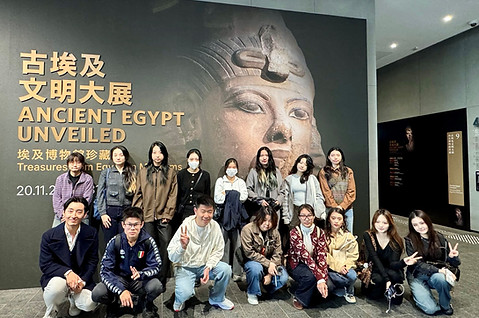
Our Philosophy students from PPE and AIES (Master of Arts in the field of AI, Ethics and Society offered by our department) gathered for a special exhibition, "Ancient Egypt Unveiled," at the Hong Kong Palace Museum. Ancient Egyptian civilisation developed sophisticated systems of governance, religion, and art. Its political structures, symbolic aesthetics, and ritual life offer enduring insights into how societies organise authority, make meaning, and express identity. By examining how ancient Egyptians thought about power, community, and cultural identity, our philosophy students trace the roots of key philosophical questions—about governance, ethics, and the self, and see how intercultural exchange and intellectual life have consistently influenced and reshaped one another.
"I was delighted to visit the Ancient Egypt exhibition at the Hong Kong Palace Museum with my classmates. While I previously had limited knowledge of ancient Egyptian culture, the exhibition provided deep insights into its history, beliefs, and mythology, significantly expanding my understanding. It is rare to encounter artefacts that are five or six thousand years old. The intricate details of the decorations and statues were astonishing. I found Egyptian mythology particularly fascinating, especially the worship of the cat goddess Bastet. The many mummified cats on display left a strong impression on me. Names like “Anubis” and “Horus,” which I had previously only encountered in games and films, seemed distant and abstract to me. However, by exploring the full cultural and religious context in which these gods were revered, I gained a much deeper and more meaningful understanding of them. I hope to see more artistic works inspired by Egyptian mythology in the future."

Hong Kong Palace Museum
Our Philosophy students from PPE and AIES (Master of Arts in the field of AI, Ethics and Society offered by our department) gathered for a special exhibition, "Ancient Egypt Unveiled," at the Hong Kong Palace Museum. Ancient Egyptian civilisation developed sophisticated systems of governance, religion, and art. Its political structures, symbolic aesthetics, and ritual life offer enduring insights into how societies organise authority, make meaning, and express identity. By examining how ancient Egyptians thought about power, community, and cultural identity, our philosophy students trace the roots of key philosophical questions—about governance, ethics, and the self, and see how intercultural exchange and intellectual life have consistently influenced and reshaped one another.
"I was delighted to visit the Ancient Egypt exhibition at the Hong Kong Palace Museum with my classmates. While I previously had limited knowledge of ancient Egyptian culture, the exhibition provided deep insights into its history, beliefs, and mythology, significantly expanding my understanding. It is rare to encounter artefacts that are five or six thousand years old. The intricate details of the decorations and statues were astonishing. I found Egyptian mythology particularly fascinating, especially the worship of the cat goddess Bastet. The many mummified cats on display left a strong impression on me. Names like “Anubis” and “Horus,” which I had previously only encountered in games and films, seemed distant and abstract to me. However, by exploring the full cultural and religious context in which these gods were revered, I gained a much deeper and more meaningful understanding of them. I hope to see more artistic works inspired by Egyptian mythology in the future."

Hong Kong Palace Museum
Our Philosophy students from PPE and AIES (Master of Arts in the field of AI, Ethics and Society offered by our department) gathered for a special exhibition, "Ancient Egypt Unveiled," at the Hong Kong Palace Museum. Ancient Egyptian civilisation developed sophisticated systems of governance, religion, and art. Its political structures, symbolic aesthetics, and ritual life offer enduring insights into how societies organise authority, make meaning, and express identity. By examining how ancient Egyptians thought about power, community, and cultural identity, our philosophy students trace the roots of key philosophical questions—about governance, ethics, and the self, and see how intercultural exchange and intellectual life have consistently influenced and reshaped one another.
"I was delighted to visit the Ancient Egypt exhibition at the Hong Kong Palace Museum with my classmates. While I previously had limited knowledge of ancient Egyptian culture, the exhibition provided deep insights into its history, beliefs, and mythology, significantly expanding my understanding. It is rare to encounter artefacts that are five or six thousand years old. The intricate details of the decorations and statues were astonishing. I found Egyptian mythology particularly fascinating, especially the worship of the cat goddess Bastet. The many mummified cats on display left a strong impression on me. Names like “Anubis” and “Horus,” which I had previously only encountered in games and films, seemed distant and abstract to me. However, by exploring the full cultural and religious context in which these gods were revered, I gained a much deeper and more meaningful understanding of them. I hope to see more artistic works inspired by Egyptian mythology in the future."